
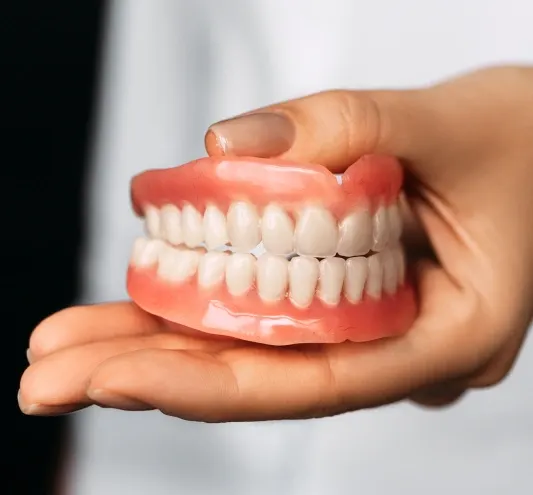
What missing teeth change — and how dentures help
Losing teeth affects far more than your smile. Chewing becomes harder, some words are tricky to pronounce, and the remaining teeth can drift into the gaps and change your bite. Without teeth to support them, the lips and cheeks can start to look sunken.
Dentures replace both the missing teeth and the gum tissue around them. They restore your ability to eat a wider range of food and speak clearly, keep remaining teeth from shifting, and support the shape of your face. For many people they are also the most affordable way to replace several teeth at once.
Types of dentures we offer
The right type depends on how many teeth you have left, the health of your gums and jawbone, and how secure you want the fit to be.
- Complete dentures — replace every tooth in the upper or lower jaw and rest over the gums. A cost-effective way to restore a full smile and facial support.
- Partial dentures — replace one or more missing teeth while keeping your natural ones. They attach with clasps or connectors, blend with your existing teeth and stop neighbors from shifting.
- Immediate dentures — made in advance so you are not without teeth on the day your remaining teeth are removed. They usually need relining as your gums heal and change shape.
- Implant-supported (snap-in) dentures — clip onto dental implants in the jaw for a far more stable fit, with no adhesives.
Snap-in implant dentures: the secure upgrade
Traditional dentures stay in place with suction and the shape of your gums, which works well for many people — especially on the upper jaw. Lower dentures in particular can lift or slide when you eat, and some patients never get used to adhesives.
Snap-in implant dentures attach to a small number of implants placed in the jawbone. They do not slip when you chew or talk, they let you bite with more strength, and the implants help preserve the bone underneath. If you are not sure which way to go, we can plan conventional dentures now with a path to implants later. Learn more about dental implants at our office.
How your dentures are made
Good dentures take a few appointments, because fit and bite matter more than anything else. The process typically looks like this:
- Exam and planning — we check your gums, any remaining teeth and the jawbone with digital X-rays, then talk through which type suits your goals and budget.
- Records — impressions or scans capture the shape of your mouth, and we record how your jaws meet.
- Choosing the look — you help select the shade and shape of the teeth so they suit your face.
- Try-in — where needed, you try a preview set so we can check fit, bite and appearance before the final denture is completed.
- Delivery and adjustments — we fit the finished denture, show you how to put it in and take it out, and make small adjustments over the following weeks.
The first few weeks with new dentures
Expect a short adjustment period. Your cheeks, tongue and lips need time to learn how to hold the denture, and most patients adapt within a few weeks. Start with soft foods cut into small pieces, chew on both sides at once, and read aloud for a few minutes a day to get used to speaking.
Sore spots are normal early on and are easy to fix. Do not try to adjust a denture yourself — call us and we will relieve the pressure point. Small adjustments are simply part of getting a comfortable fit.
Why patients choose our Dentures Howell team
Choosing dentures is a big decision, and you deserve real options rather than a sales pitch. Our dentists explain the trade-offs between conventional and implant-supported dentures in plain language, and Dr. Abraham Y Husney holds a Diplomat Certificate of Completion from a Dental Implant Surgical Seminar, so implant options are planned and placed in the same office.
- 5.0 stars from 537+ Google reviews
- Extractions, bone grafting, implants and dentures all under one roof
- In-network with 32 PPO plans, plus in-house and third-party financing
- Open every Sunday from 9 am to 3 pm, close to Farmingdale, Freehold, Jackson and Lakewood
Caring for your dentures
Brush your dentures daily with a soft brush to remove food and plaque, and rinse them after meals. Take them out at night and keep them in water or a soaking solution so they do not dry out, and clean your gums and tongue every day.
Keep up regular checkups even if you have no natural teeth left. Your gums and jawbone change over time, and a denture that once fitted perfectly may need a reline. We also check the soft tissues of your mouth for any problems. Ready to talk about your options? Book online or call.
Dentures Howell: frequently asked questions
How much do Dentures Howell patients typically pay?
How long does it take to get used to dentures?
Should I sleep in my dentures?
What is the difference between a partial denture and a bridge?
Are snap-in dentures better than regular dentures?
Why should I replace missing teeth at all?
Talk through your denture options
Book a consultation online or call (732) 751-4028. We will explain full, partial and snap-in options and give you a written plan and price.