
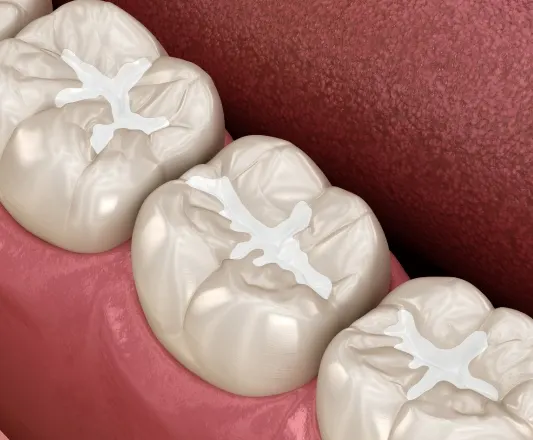
What sealants are and why back teeth need them
The chewing surfaces of molars and premolars are not smooth. They are covered in narrow pits and grooves, many of them thinner than a single toothbrush bristle. Food and bacteria settle into those grooves and stay there, which is why so many cavities start on the tops of back teeth.
A sealant is a thin, tooth-colored coating that flows into the grooves and hardens. It turns a deeply grooved surface into a smoother one that is far easier to keep clean, and it physically blocks bacteria from reaching the enamel underneath.
Who benefits from sealants
Sealants are most often associated with children, but they make sense for anyone with deep grooves and no existing decay on those surfaces.
- Children and teens — the first permanent molars usually appear around age 6 and the second around age 12. Sealing them soon after they erupt protects them through the most cavity-prone years, into the mid-teens.
- Young children at higher risk — in some cases we seal baby molars, especially if a child has already had cavities.
- Adults — if your back teeth have deep grooves but no decay, sealants can still help prevent future cavities as part of a preventive plan.
Dental Sealants Howell: how they're applied
The process is quick and comfortable, and it usually takes just a few minutes per tooth. There is no drilling and no injection, which makes it an easy first experience for young patients.
- The tooth is cleaned thoroughly and dried.
- Cotton or a small barrier keeps the tooth dry while we work.
- A mild solution is applied to slightly roughen the surface so the sealant can bond.
- The tooth is rinsed, dried again and the sealant is painted into the grooves.
- The sealant hardens on its own or with a special curing light.
Sealants and fluoride: how they work together
Fluoride and sealants protect teeth in different ways. Fluoride strengthens the enamel on every surface and helps it resist acid. Sealants protect the specific grooves that toothbrush bristles and fluoride have trouble reaching.
Used together with good brushing, flossing and six-month checkups, they give children's teeth a strong chance of reaching adulthood without fillings. At each visit we check that sealants are still intact and touch them up if part has worn away.
After the sealant is on
There is no recovery time. Because the coating hardens before you leave the chair, most children go straight back to school or home and can usually eat normally that day. Some kids notice that their back teeth feel slightly different at first; that feeling typically fades within a day or two as they get used to it. We check the bite before you leave so nothing feels high.
Sealants are tough, but they are not indestructible. Chewing ice, hard candy or pens can chip them, so it helps to steer children away from those habits. If a sealant ever feels rough or seems to be missing, let us know and we will check it at the next visit.
A family-friendly office in Howell
Children pick up on how adults feel about the dentist, so we keep visits calm, explain things in kid-friendly words and never rush. Parents can often book siblings back to back, and our family dentistry team sees patients of every age.
Sunday hours from 9 to 3 mean you can fit a sealant visit around school without pulling anyone out of class. Families from Howell Township, Farmingdale, Jackson and Lakewood are an easy drive from our office at 4034 US-9.
What sealants cost
Sealants are an inexpensive way to avoid the cost of fillings later. Many PPO plans include sealants for children, sometimes with age or tooth limits, so our coordinators check exactly what your plan pays before the visit. We are in-network with 32 PPO plans.
For families without insurance, our membership plans include two cleanings and exams a year, a fluoride treatment for children, and 10% off procedures. Book online or call to add sealants to your child's next checkup.
Dental Sealants Howell: frequently asked questions
How long does a Dental Sealants Howell appointment take?
How long do sealants last?
Does getting a sealant hurt?
Are sealants only for children?
Can a sealant be placed over a cavity?
Do sealants replace brushing and flossing?
Protect those new molars
Book online or call (732) 751-4028 to add sealants to your child's next visit — or ask whether they make sense for you.