
When a tooth needs a crown
A crown — often called a cap — covers the entire visible part of a tooth. It holds a weakened tooth together, restores its shape so you can chew normally, and gives it a natural color again.
We recommend a crown only when a filling would not be strong enough. Typical reasons include:
- A cracked or broken tooth that is at risk of splitting further
- A tooth with a large filling and little natural structure left around it
- A back tooth after a root canal, which tends to become brittle
- Teeth that are badly worn from grinding
- A front tooth that is heavily discolored or misshapen
How a crown is made: two visits, done carefully
A crown is custom-made for one tooth, so it takes two appointments. At the first, we prepare the tooth and record its exact shape; at the second, we fit the permanent crown. In between, a dental lab makes your crown to our specifications.
You won't go without a tooth in the meantime. A temporary crown protects the prepared tooth and lets you eat and smile normally. It is held with softer cement on purpose, so avoid sticky and very hard foods on that side, and call us if it loosens — we'll re-cement it quickly.
Your crown appointments, step by step
Most of the time goes into fit and bite, because that is what makes a crown last. Here is what happens:
- Exam and X-ray — we confirm a crown is the right fix (and not a filling or onlay) and check the root and bone with digital X-rays.
- Numbing and preparation — the tooth is numbed, any decay is removed, and the tooth is shaped so the crown fits securely.
- Impression and shade — we record the shape of the prepared tooth and your bite, and choose a shade that blends with your neighboring teeth.
- Temporary crown — a temporary is fitted the same day so the tooth is covered while your crown is made.
- Fitting and bonding — at the second visit we remove the temporary, try in the permanent crown, check the margins and how it meets your other teeth, then bond it in place.
Dental bridges for missing teeth
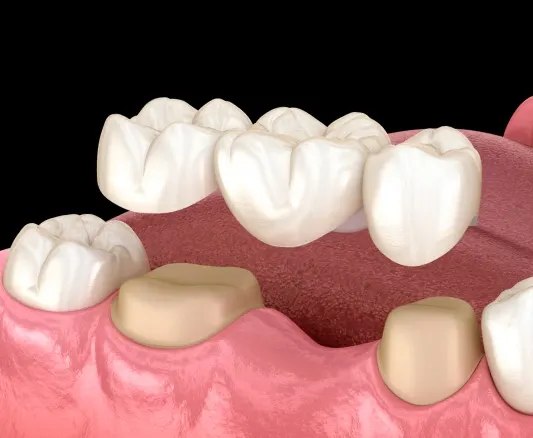
A bridge replaces one or more missing teeth by anchoring a false tooth, called a pontic, to crowns on the healthy teeth on either side of the gap. It is fixed in place — you do not take it out at night — and it stops neighboring teeth from drifting into the space and throwing off your bite.
Bridges suit patients who prefer a non-removable option over a partial denture. If the teeth next to the gap are healthy and you would rather not have them shaped for crowns, an implant or implant-supported bridge may be a better long-term choice. We will explain the trade-offs of each.
Onlays: a more conservative option
Sometimes only part of a tooth is damaged — one or two cusps have broken, but the rest is sound. An onlay is a custom restoration that rebuilds just the missing chewing surface and bonds to the remaining tooth.
Because less healthy tooth is removed than for a full crown, an onlay can be a good middle ground between a large filling and a crown. We will tell you honestly which one your tooth needs.
Why patients choose our Dental Crowns Howell team
Crowns are only as good as their fit. A crown that sits slightly high or leaves a ledge at the gumline can trap food and fail early. Our dentists — Dr. Abraham Y Husney and Dr. Justin Nus — check the margins and your bite carefully before anything is bonded.
- Crowns checked for fit, margins and bite before anything is bonded
- Digital X-rays with up to 80% less radiation and intraoral camera photos so you see the problem yourself
- 5.0 stars from 537+ Google reviews
- Comfort aids and sedation options for anxious patients
- Open every Sunday, with appointments that run on time
Cost, insurance and caring for your crown or bridge
Crowns and bridges are usually classed as major care, which PPO plans typically cover at around 50% depending on your plan. Our coordinators verify your benefits with any of the 32 PPO plans we are in-network with and give you a written estimate. Flexible payment plans and financing are available for the remaining balance.
With good care, crowns and bridges commonly last 5 to 15 years or longer. Brush and floss daily — especially around the base and under the bridge — avoid chewing ice or hard objects, and wear a night guard if you grind. If your plan year is ending, start early so both crown visits fall in the same benefit year.
Dental Crowns Howell: frequently asked questions
Dental Crowns Howell: how many visits does a crown take?
Is a crown or a bridge right for me?
Does getting a crown hurt?
How long do crowns and bridges last?
What is the difference between an onlay and a crown?
Will my crown match my other teeth?
What should I do if my temporary crown comes off?
Protect that cracked tooth before it splits
Book online or call (732) 751-4028 to find out whether a crown, onlay or filling is right for your tooth. We are open every Sunday.